
Dosage • Ingredients • Safety
How Much Cream of Tartar Per Day? Tarsul Dosage and Ingredients
A plain guide to how much to take, how to measure it, what is in Tarsul, and when to check with your doctor first. Calm, clear, and sourced.
See Tarsul Capsules and Powder →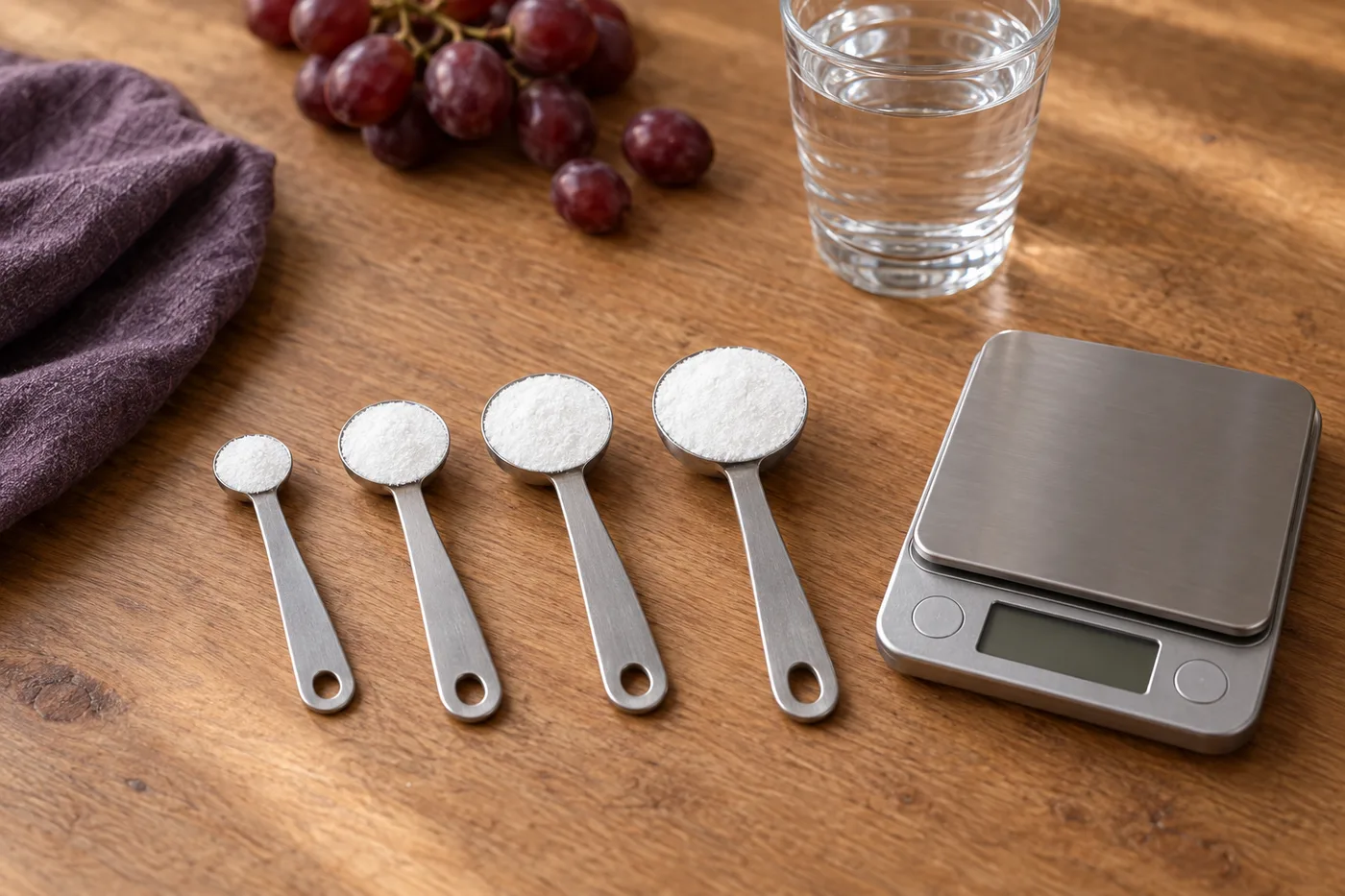
Short answer
- There is no official amount per day for cream of tartar itself. What matters is the potassium it supplies.
- For Tarsul powder, the suggested use is half to one level tsp in 8 ounces of water or juice, one to three times daily. For capsules, it is 4 capsules, with a range of 1 to 8 depending on body size and individual response.
- Start at the low end of the range and follow the label, or the directions of your health care professional.
- Do not go above the label. The serious cases in the medical literature involved people taking many times that amount at once.
- If you have kidney problems or take an ACE inhibitor, an ARB, or a potassium-sparing diuretic, talk with your doctor before you start.
This page is general information, written by our founder. It is not medical advice. Always follow the label on the product you have, because labels take priority over anything written here.
What We Know About Cream of Tartar Dosing
If you have searched for an exact number, you have probably noticed that most pages avoid giving one. That is not an accident. Cream of tartar has no official recommended amount, because it is not a nutrient in itself. It is a carrier for one: by weight it is close to 21 percent potassium (Journal of Medical Toxicology).
The useful reference point is the adequate intake for that mineral from all sources: 3,400 mg for adult men and 2,600 mg for adult women (NIH Office of Dietary Supplements). Most of that should come from foods such as fruits, vegetables, beans, and dairy. A supplement fills part of the gap, not all of it. Experts have not set an upper limit, but the same NIH fact sheet notes that very large supplement amounts can overwhelm the kidneys even in healthy people.
So the honest guidance is simple. Use a measured amount, start at the low end of the label range, keep it steady, and let your doctor guide anything beyond the label.
Two Ingredients: A Tartaric Acid Salt and MSM
Tarsul contains two ingredients and no proprietary blend. It is made mainly from cream of tartar, with a smaller amount of MSM.
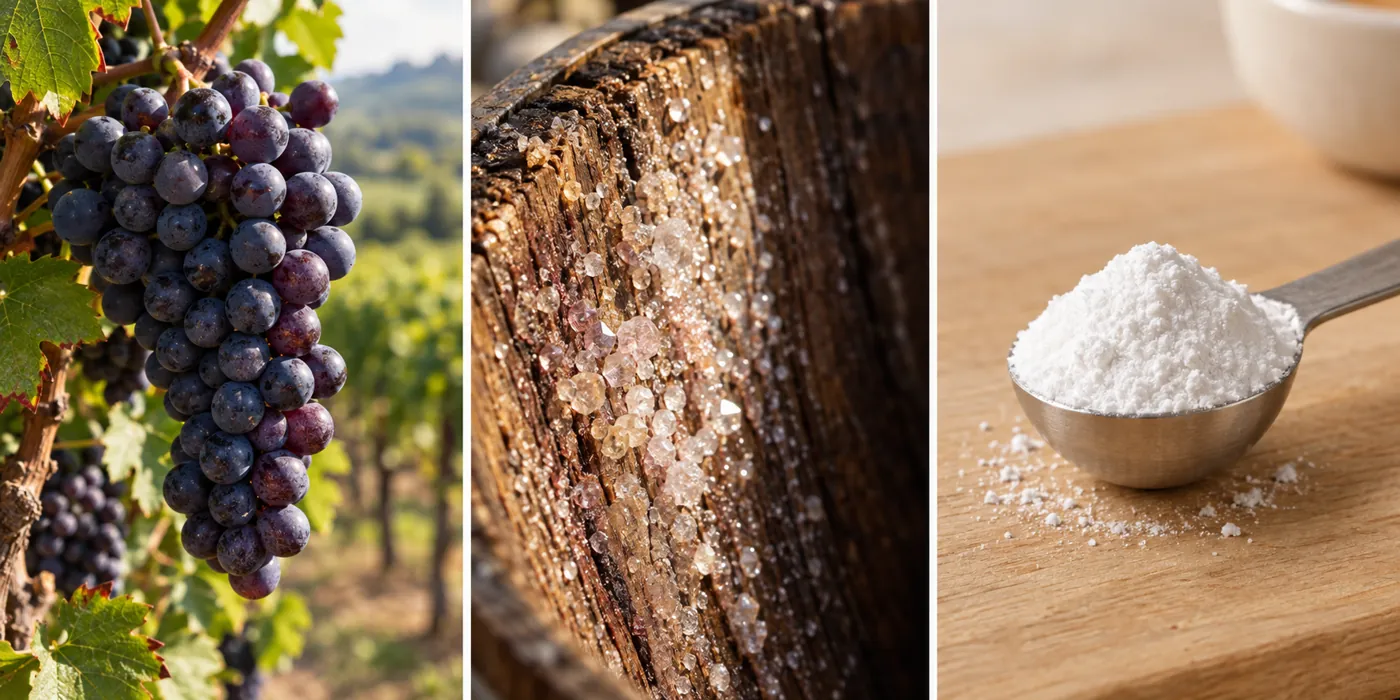
Cream of tartar. As grape juice ferments into wine, tartaric acid and the mineral from the fruit crystallize inside the barrel. Those crystals are purified into a fine white powder (University of Illinois Extension). The FDA lists it as a food ingredient that is Generally Recognized as Safe (21 CFR 184.1077). Read more in our guide to cream of tartar benefits.
MSM (methylsulfonylmethane). MSM is a sulfur compound found in small amounts in many foods. It is widely used in supplements and is generally described as well tolerated (Butawan et al., Nutrients, 2017). Read more on our MSM page.
How to Take Tarsul
These directions match our new label, arriving in late 2026.
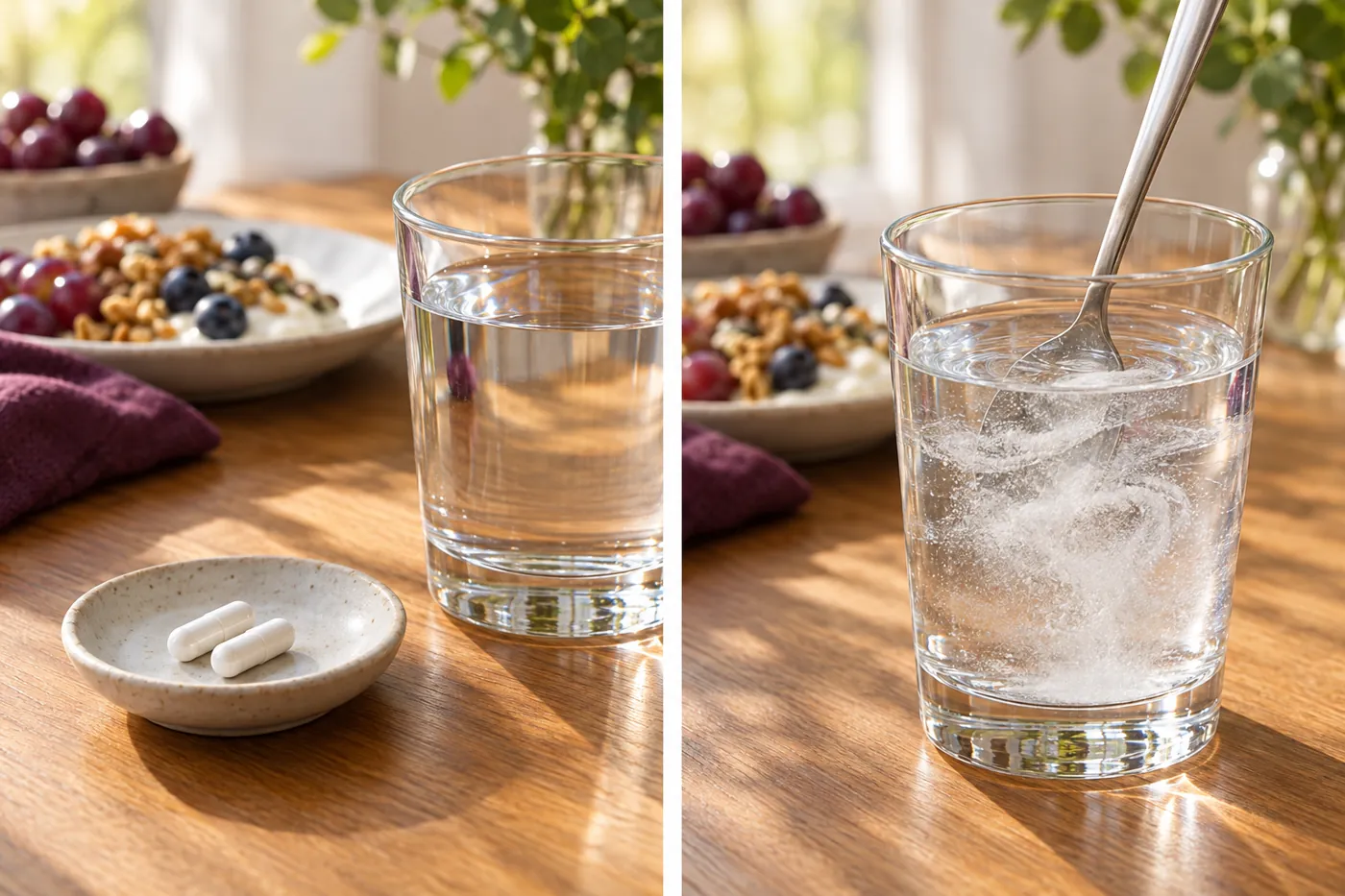
Powder: mix half to one level spoonful into 8 ounces of water or juice, one to three times a day, or as directed by your health care professional. Stir until dissolved and drink. Do not mix it into hot liquid. The taste is mildly tart, a little like lemonade without the sugar.
Capsules: take 4 capsules with water, or as directed by your health care professional. Some people take as few as 1 or as many as 8; the amount varies with body size and individual response. If you have been looking for sulfur and cream of tartar tablets, the capsules are Tarsul’s pill form; there is no separate tablet.
Please start at the low end. At the very top of the powder range, three level spoonfuls in 24 hours, our estimate is roughly 2,500 mg of the mineral, which is a substantial amount on top of what you eat. That is fine for many healthy adults and not for everyone, so the cautions below matter.
Pick a time you will remember. Many customers take it in the morning. If your stomach is sensitive, take it with a meal, because concentrated mineral supplements can cause minor stomach upset (NIH fact sheet). Use one format at a time rather than combining capsules and powder.
If the label on the product in your hands reads differently, follow your label. Questions are welcome at our contact page.
Measuring Spoons and Grams
A level spoon and a heaped spoon can differ a lot, so it helps to see the numbers. The figures below use USDA data for cream of tartar (USDA data via URMC) and its chemical formula.
| US measuring spoon | Approximate weight | Approximate potassium |
|---|---|---|
| 1/8 | about 0.4 g | about 60–80 mg |
| 1/4 | about 0.75 g | about 125–155 mg |
| 1/2 | about 1.5 g | about 250–310 mg |
| 1 level | about 3 g | about 495–620 mg |
| 1 tablespoon | about 9 g | about 1,500–1,870 mg |
In baking, the amounts are tiny. A recipe might call for 1/4 tsp cream of tartar spread across a whole batch of cookies, or a small amount to help egg whites whip. That is where cream of tartar can help most cooks, and in baking amounts none of the cautions on this page apply. Tarsul is pure cream of tartar plus MSM, so a Tarsul serving supplies a little less of the mineral than the same spoon of plain cream of tartar.
Hyperkalemia Risks: Why More Is Not Better
Hyperkalemia means too much of this mineral in the blood. It can be silent, but severe cases cause muscle weakness, tingling, palpitations, and dangerous heart rhythms (NIH Office of Dietary Supplements). It is the main reason we ask you to respect the label.
The published cases show what an electrolyte imbalance of this kind looks like. In 2013, doctors described two healthy young men who each drank about six tablespoons, roughly 84 grams, to clean themselves out. Both needed hospital care (Rusyniak et al., 2013). In 2025, a 70-year-old woman with no known kidney problems took 166 grams for constipation and had a cardiac arrest before recovering (Medical Journal of Australia). Nobody should ever take a tbsp cream of tartar dose, let alone several.
Stop and seek medical care if you notice unusual weakness, numbness or tingling, or a racing or irregular heartbeat.
Medication Interactions and Who Should Ask First
Some people clear this mineral more slowly, so even a normal serving can add up. Please talk with your doctor or pharmacist before you start if you:
- Have kidney disease or reduced kidney function.
- Take an ACE inhibitor such as benazepril or lisinopril, or an ARB such as losartan. These are common blood pressure and heart medicines.
- Take a potassium-sparing diuretic such as spironolactone or amiloride.
- Use a salt substitute or another mineral supplement.
- Have type 1 diabetes, heart failure, adrenal insufficiency, or liver disease.
- Are pregnant or nursing, or are thinking about it for a child.
Those risk factors and medicines come straight from the NIH fact sheet (NIH on medication interactions). A basic metabolic panel, a routine lab test, shows where you stand.
Nutrition Facts at a Glance
Cream of tartar is almost pure mineral salt. According to USDA data, a level spoon has about 8 calories, about 2 grams of carbohydrate, and almost no sodium, and it has no vitamin content to speak of (USDA nutrition facts). Consuming only the label serving adds a real amount of one mineral and essentially nothing else.
Why We Do Not Publish Condition-Specific Doses
People sometimes ask whether to take more for one concern and less for another. An older version of this page had a table like that, and we took it down. Tarsul is a dietary supplement, not a medicine. Matching an amount to a health condition is something only your own clinician can do responsibly, because they know your kidneys, your medicines, and your lab results. Following the label range, starting low and staying steady, is what we recommend.
When you are ready, see Tarsul capsules and powder. Orders over $50 ship free, and every order comes with a money-back guarantee for 30 days.
Have a Question? Ask Us
Search our guides, or send us a note. A real person at Tarsul reads every message.
Frequently Asked Questions
How much cream of tartar per day is safe?
There is no official daily amount for cream of tartar, and no upper limit has been set for potassium. For Tarsul, follow the suggested use on the label: half to one level teaspoon of powder one to three times a day, or 4 capsules (1 to 8 depending on the person). Published poisoning cases involved about 84 to 166 grams taken at once, many times the label amount, and people with kidney problems or on potassium-raising medicines can run into trouble at much lower amounts.
Can I take cream of tartar every day?
Many people take Tarsul every day as a routine, following the label. Your body uses potassium every day and does not store much of it. If you have kidney problems or take a medicine that affects potassium, ask your doctor first.
Can I just use cream of tartar from the baking aisle?
It is the same compound, but a kitchen spoon is easy to overfill, and a heaped tablespoon is a large dose. Tarsul is measured into consistent servings so you do not have to guess.
What time of day should I take Tarsul?
Whatever time you will remember. Many people take it in the morning with a full glass of water. If your stomach is sensitive, take it with a meal.
What if I miss a serving?
Just take your next serving as usual. Do not double up to make up for it.
Does Tarsul have calories?
Almost none. A level teaspoon of cream of tartar has about 8 calories and 2 grams of carbohydrate, according to USDA data.
Are the capsules and powder the same?
Yes. They contain the same two ingredients in different formats. Follow the serving on the label of the format you have, and do not combine the two.
Sources
NIH Office of Dietary Supplements. Potassium: Fact Sheet for Health Professionals.
Code of Federal Regulations. 21 CFR 184.1077.
USDA FoodData Central, cream of tartar, as presented by University of Rochester Medical Center.
Rusyniak DE, et al. Life-Threatening Hyperkalemia from Cream of Tartar Ingestion. Journal of Medical Toxicology. 2013;9(1):79–81.
Ng DYL, et al. Hyperkalaemic cardiac arrest due to cream of tartar ingestion. Medical Journal of Australia. 2025;222(11).
Butawan M, Benjamin RL, Bloomer RJ. Methylsulfonylmethane: Applications and Safety of a Novel Dietary Supplement. Nutrients. 2017;9(3):290.
University of Illinois Extension. Cream of tartar: From winery byproduct to baking essential.
About this page — last reviewed October 2026
Written by Russ Guillemot, founder of Tarsul. Tarsul is a family-run dietary supplement company in San Diego, California, selling since 2010. We are not physicians, and nothing on this page is a diagnosis or a treatment plan. Where we cite research, we link to it so you can read it yourself.
Tarsul · 2307 Fenton Parkway #107-42, San Diego, CA 92108 · 619-500-4403 · info@tarsul.com
These statements have not been evaluated by the Food and Drug Administration. This product is not intended to diagnose, treat, cure, or prevent any disease.