
The best Candida Overgrowth Supplements don’t just attack yeast directly. They restore the minerals your gut needs so yeast loses its advantage in the first place.

That’s the part most guides skip. They focus on what to avoid, not what your body is missing.
Why the “Starve the Yeast” Diet Often Falls Short
Most Candida advice starts with one rule: cut sugar. It makes sense on paper. Yeast feeds on sugar, so less sugar should mean less yeast.
But Weig and colleagues tested exactly this in the American Journal of Clinical Nutrition in 1999 (PubMed 10357735), putting 28 healthy volunteers on a high-refined-carbohydrate diet and measuring Candida albicans counts in mouth washes and stool before, during and after. They found no correlation between habitual refined carbohydrate intake and Candida counts, and concluded that adding a large amount of refined carbohydrate to a healthy person’s diet has limited influence on Candida colonization.
What does this tell us? A strict candida diet alone often isn’t enough. The bigger issue is the internal environment, not just the fuel supply.
If you’ve cut sugar and still feel off, this is probably why.
What Candida Overgrowth Actually Feels Like
Candida symptoms are easy to dismiss. They build slowly and overlap with everyday tiredness.
Common signs include:
- Afternoon brain fog
- Sugar cravings that won’t quit
- Bloating after meals
- Recurring skin issues
- Low energy that sleep doesn’t fix
- Joint stiffness that seems to come from nowhere
These symptoms often show up in different combinations from person to person. That’s part of why candida overgrowth is so easy to misread as stress, poor sleep, or “just getting older.” If a few of these sound familiar and they’ve stuck around for weeks, it’s worth looking at your gut balance as a possible cause.
Can You Have Candida Without Symptoms?
Yes. Everyone has some candida in their gut. It’s normal. Problems start when it overgrows and throws your gut balance off. Some people carry higher levels for years before symptoms show up.
Can a Man Get Candida?
Absolutely. Candida overgrowth isn’t limited to women. Men can experience digestive symptoms, fatigue, and even a candida yeast skin rash in areas like the groin or underarms. It’s just talked about less.
The Root-Cause Approach: Minerals Over Antifungals
Here’s the part that doesn’t get enough attention. Two minerals, potassium and sulfur, play a direct role in keeping your gut balanced.
When levels run low, your gut lining weakens. A weaker lining makes it easier for yeast to colonize and harder for your body to bounce back.
This is where most candida treatment plans miss a step. Killing yeast without rebuilding the gut often leads to the same cycle repeating months later.
A 2017 study on MSM (methylsulfonylmethane) found that MSM raised glutathione and other protective compounds in stomach tissue. We want to be precise about what that study was: it was conducted in mice, and it looked at the gastric lining rather than the intestine. Glutathione is the body’s main antioxidant and sulfur is required to make it, which is the connection worth understanding — but a mouse stomach study is not evidence of what an oral supplement does to a human gut, and we are not going to present it as though it were.
Think of it this way. Antifungals clear out the overgrowth you can see. Mineral support works on the conditions that let it grow back. Without both pieces, you’re often just resetting the clock.
Standard Protocols vs. Mineral-Restoration Approach
Here’s how the two approaches compare side by side:
| Approach | What It Does | Common Drawback |
|---|---|---|
| Antifungal medication | Kills yeast cells directly | Doesn’t fix mineral depletion behind regrowth |
| Strict sugar-free diet | Cuts yeast’s fuel source | Limited effect on its own, per research |
| Mineral and sulfur restoration | Rebuilds gut lining and balance | Takes consistency over a few weeks |
No single approach works in isolation. But the mineral piece is the one most people leave out.
A Two-Phase Way to Support Your Gut
We like to think of Candida support in two simple phases.
Phase 1: Cleanse
Cream of tartar (potassium bitartrate) helps shift your gut’s pH. A balanced pH makes it harder for yeast to thrive and easier for good bacteria to do their job.
Phase 2: Restore
MSM sulfur supports the repair of your gut lining. As mentioned earlier, sulfur plays a role in glutathione production, which helps protect and rebuild that lining over time.
Together, these two steps address both sides of the problem: the environment yeast lives in and the gut wall it damages.
If you want to see how this fits into a bigger picture of daily wellness, check out 16 ways Tarsul helps in whole-body fitness.
Why Consistency Matters More Than Intensity
One thing we’d point out is candida overgrowth doesn’t build up in one night, and it also doesn’t just disappear in one night either. A lot of people go full force for a week, then they see no change, and they pretty much quit. But gut balance doesn’t flip instantly; it shifts gradually. Keeping up with a routine for a few weeks tends to matter more than how hardcore any one single step is.
Little and steady tweaks to your mineral intake, paired with some everyday dietary awareness, give your gut time to rebuild in its own rhythm.
Final Thoughts
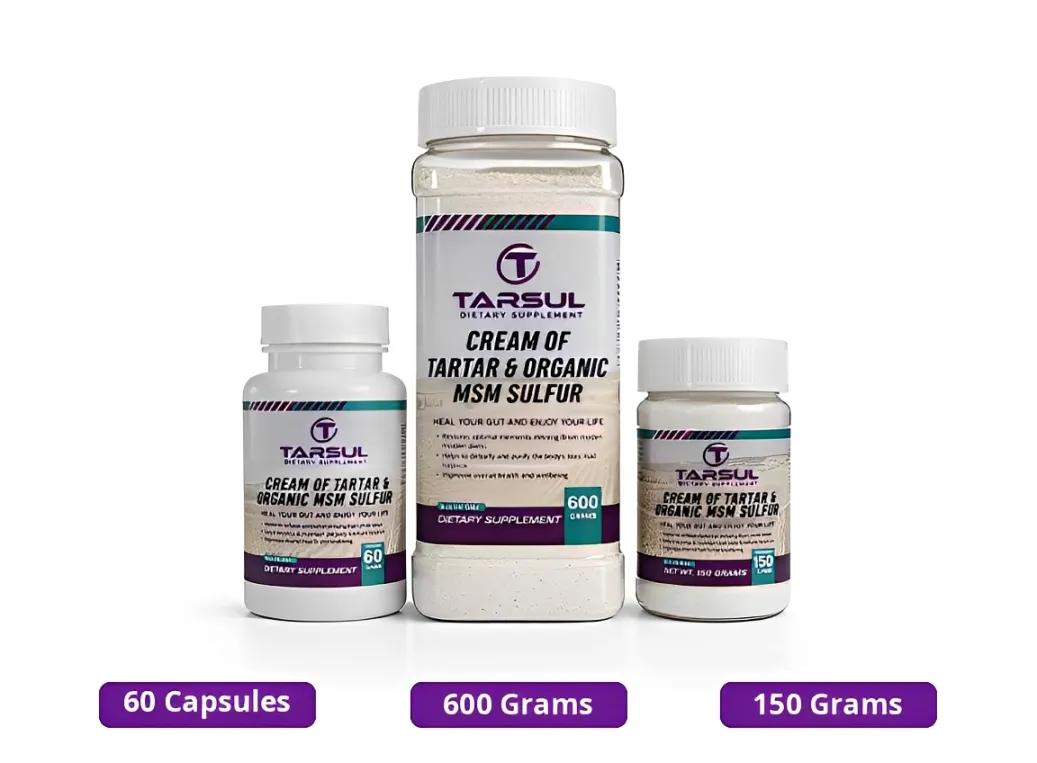
Candida overgrowth isn’t only about knocking down yeast. It’s more like helping your gut get the minerals it requires so things can keep a kind of balance on their own. If you’re after a straightforward way to nudge that equilibrium, Tarsul brings cream of tartar and MSM sulfur together into one simple daily routine. Give your gut what it’s been missing, and the rest usually falls into place.
Frequently Asked Questions
Is Candida a Sexually Transmitted Infection?
No, candida isn’t classified as an STI. However, it can pass between partners during an active infection. It’s more accurately described as an overgrowth issue than a transmitted disease.
How Do You Test for Candida Overgrowth in the Gut?
A stool test or organic acid test can show candida levels. Your doctor may also review symptoms alongside lab results, since candida overgrowth doesn’t always show up the same way for everyone.
How Do You Treat Candida Overgrowth in the Gut?
Treating Candida overgrowth in the gut usually means you combine a few things that work together. First you lower what feeds the yeast, then you give some real support to the gut lining and also restore key minerals like potassium and sulfur. When those three tracks line up, your body has a better chance at longer-lasting equilibrium, not just a quick calm down.
How to Cure Candida Naturally and Permanently?
Honestly, there isn’t any instant thing. What matters most is steady intestinal rebuilding over weeks, not days, and doing it consistently. Try to improve the overall gut environment, like rebuilding the terrain, so yeast has less opportunity to come right back and settle in.
Medical Disclaimer
This article is intended for educational purposes only and should not be interpreted as medical advice, diagnosis, or treatment. Always consult a qualified healthcare professional regarding persistent symptoms or before beginning any new supplement regimen.
More on this topic: see the Candida and Yeast-Related Symptom Information hub for the full set of related articles.
Related reading on this topic
- Gut Health Supplement for Candida
- Natural Alternative to Diflucan / Fluconazole for Candida
- Natural Supplement for Systemic Candida
- Best Natural Supplement for Candida Overgrowth
- What is actually in Tarsul, and how it is taken
About this page — last reviewed September 2026
Published by Tarsul, a family-run dietary supplement company operating from San Diego, California since 2010. Written and reviewed in-house by Russ Guillemot, founder, drawing on fifteen years of direct correspondence with customers and wholesale accounts. We are not physicians and nothing here is a diagnosis or a course of treatment.
Where we reference published research we name the authors and the journal so you can look it up yourself. Where something is a common observation rather than a finding, we say so plainly. If a claim cannot be sourced, we leave it out.
Tarsul · 2307 Fenton Parkway #107-42, San Diego, CA 92108 · 619-500-4403 · info@tarsul.com
These statements have not been evaluated by the Food and Drug Administration. This product is not intended to diagnose, treat, cure, or prevent any disease.