
Most IBS dietary supplements focus on one symptom: constipation, diarrhea, or bloating. But long-term digestive balance comes from addressing the mineral deficiencies that destabilize the gut environment in the first place. Two nutrients are consistently overlooked: sulfur and potassium.
Why Most IBS Strategies Keep You Stuck
You’ve probably tried fiber supplements. Maybe probiotics. Perhaps a strict elimination diet. And yet the flare-ups keep coming.
Here’s what most IBS content won’t tell you: many popular prebiotic fibers and gut supplements contain fermentable carbohydrates. In a sensitive gut, those fermentable carbs feed harmful bacteria, triggering the exact gas, cramping, and bloating you’re trying to fix.
The cycle continues not because you haven’t tried hard enough. It continues because the approach targets the surface, not the structural root.
What’s Actually Happening Inside an IBS Gut?
The Gut Wall Is Breaking Down, Not Just Acting Up
The gut’s inner lining is a single layer of epithelial cells. It acts as a barrier between intestinal contents and your bloodstream. In people with IBS, chronic low-grade irritation degrades this cellular barrier over time. The gut becomes hyperreactive, responding to ordinary foods as if they were threats.
Organic sulfur (MSM) is a structural building block for the proteins that hold this barrier together, specifically occludin, claudin-1, and ZO-1. A 2017 peer-reviewed review published in Nutrients by Butawan, Benjamin, and Bloomer at the University of Memphis confirmed MSM’s anti-inflammatory and antioxidant mechanisms at the tissue level, including its recognized GRAS (Generally Recognized as Safe) safety status (PMC5372953).
Supporting the gut wall structurally is a step most dietary supplements for IBS never take.
Your Digestive Muscles Need the Right Electrical Signal
IBS is fundamentally a brain-gut communication disorder. The enteric nervous system, sometimes called the “second brain,” sends erratic signals to intestinal smooth muscles. That’s what causes the painful cramping and unpredictable alternation between constipation and diarrhea.
Potassium plays a direct role here. It supports cellular fluid balance and nerve conduction, helping smooth muscle contractions become more regular without artificially blocking or forcing transit.
There’s also the Migrating Motor Complex (MMC) to consider. Between meals, the gut runs a natural sweeping cycle to clear waste and prevent bacterial overgrowth. Proper mineral balance keeps this cycle running efficiently. When potassium is depleted, the MMC breaks down, creating the conditions for SIBO and worsening symptoms of irritable bowel syndrome over time.
Conventional IBS Management vs. Mineral-Sulfur Support
| Management Approach | Conventional Symptom-Blockers | Mineral & Sulfur Support |
|---|---|---|
| Primary Action | Artificially forces motility or numbs local nerves | Nourishes gut tissue and calms muscle signaling |
| Gut Lining Impact | No effect on mucosal tissue integrity | Supports barrier protein production |
| Systemic Synergy | Can create dependency or flip-flop symptoms | Balances natural mineral levels for regularity |
| Formulation Profile | Often contains dyes, fillers, and binders | Pure elemental nutrients, no fermentable fillers |
| Long-Term Strategy | Relies on restrictive elimination diets | Builds a resilient internal gut environment |
Among the various IBS therapies available today, from antispasmodics to low-FODMAP protocols, none consistently address both the mucosal barrier and smooth muscle signaling at the same time.
A Two-Phase Approach to Restoring Gut Balance
Phase 1: Tackling the Microbial Environment First
Chronic IBS is often driven by dysbiosis, an overgrowth of harmful gut bacteria.
MSM sulfur has documented antimicrobial properties. It helps reduce bacterial overgrowth and creates a cleaner microbial environment. That matters because a dysbiotic gut keeps inflaming regardless of what you eat.
This differs from standard irritable bowel syndrome treatments that use antispasmodics or antidiarrheals to manage flare symptoms temporarily. Phase 1 is about changing the environment, not suppressing the reaction.
Phase 2: Rebuilding the Mineral Foundation
Once the microbial environment begins to stabilize, the gut can start rebuilding.
Potassium restores the electrolyte balance that smooth digestive muscles depend on. Sulfur continues to support intestinal wall integrity. Together, they address both motility and structure, making this a more complete approach to irritable bowel syndrome treatment than fiber bulking or symptom blockers alone.
The practical advantage: dosage can be adjusted in real time. Higher during an acute flare, reduced to a daily maintenance level as balance returns. That flexibility is something fixed-dose capsule regimens rarely offer.
What to Actually Look for in Supplements to Help IBS
Not all supplements are equal for a sensitized gut. Here’s what matters:
- Non-fermentable formula: avoids triggering gas in a bacteria-heavy gut environment
- Filler-free profile: artificial sweeteners, synthetic anti-caking agents, and chemical binders can disrupt a fragile microbiome
- Water-soluble delivery: bypasses heavy digestive workload; active minerals reach gut tissue directly
- Flexible dosing: allows real-time adjustment based on symptom severity
- Two clearly identified ingredients: full transparency on what you’re putting into an already-stressed digestive system
These criteria are worth applying to any supplements to help IBS you’re currently using or considering.
Managing IBS Day-to-Day: The Predictability Shift
The biggest burden of IBS isn’t always the physical pain. It’s the unpredictability.
When you’re managing a flare, heavy laxatives or intense anti-diarrheal agents often swing the gut from one extreme to the other. Finding a stable middle ground, a consistent and smooth elimination, is what actually restores daily confidence.
For IBS diarrhea specifically, the goal isn’t to block output. It’s to normalize the motility signals causing urgency in the first place. Potassium’s role in nerve conduction is central to that. A stressed gut also absorbs nutrients poorly. A clean, water-soluble mineral formula bypasses heavy digestive workload, delivering active support at the cellular level rather than adding more bulk to an already reactive system.
If you’re also dealing with overlapping concerns like energy, skin, or inflammation, it’s worth reading about 16 Ways Tarsul Supports Whole-Body Wellness, where many of the mechanisms discussed connect directly to gut health.
The Role of a Recommended IBS Diet Alongside Supplementation
Supplements work better with the right dietary foundation. The recommended IBS diet approach isn’t just about removing trigger foods. It’s about reducing the fermentation load in the gut while giving the intestinal environment the minerals it needs to stabilize.
A few practical principles worth following:
- Reduce high-FODMAP foods during active flares, not permanently, but to lower bacterial fermentation while the gut heals.
- Hydrate consistently: potassium balance depends on adequate water intake.
- Avoid artificial sweeteners: many act as gut irritants and alter the microbiome.
- Eat smaller, more frequent meals: reduces the volume hitting a sensitized digestive system at one time
Mineral supplementation and clean eating work as a system. One without the other is slower to show results.
IBS Natural Supplements: What the Evidence Actually Supports
Many products marketed for gut health lack clinical backing. Here’s how the evidence breaks down honestly:
- Probiotics: inconsistent results in clinical trials for IBS; some strains help, many show no significant effect
- Fiber supplements: effective for constipation-dominant IBS, but fermentable types worsen gas and bloating
- Peppermint oil: some evidence for cramping relief, but limited in scope
- MSM (organic sulfur): supported by peer-reviewed research for anti-inflammatory effects, barrier protein support, and oxidative stress reduction at the tissue level
- Potassium (via Cream of Tartar): essential for smooth muscle function and digestive motility; depletion is well-documented in Western diets
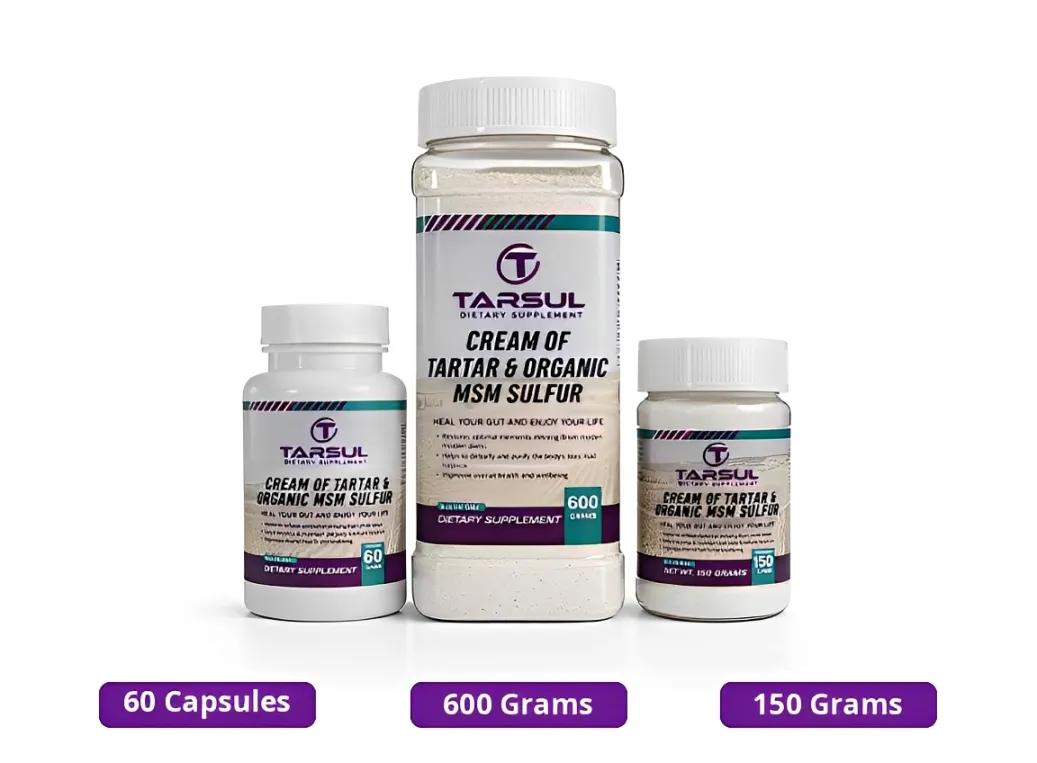
Among IBS natural supplements, the combination of MSM and potassium bitartrate is one of the few approaches that targets both the gut wall and the nerve-muscle signaling problem simultaneously. Tarsul combines both in a filler-free, two-ingredient formula made in the USA.
Frequently Asked Questions
How do I help IBS naturally?
Start by identifying mineral deficiencies, particularly sulfur and potassium, alongside clean eating and consistent hydration. Reducing fermentable carbohydrates during flares also helps lower the bacterial load driving inflammation.
How do I relieve IBS pain during a flare-up?
Reduce fermentable food intake, support electrolyte balance with a potassium source, and avoid agents that overcorrect gut motility in one direction. The goal is to calm the nerve-muscle signaling, not block transit entirely.
What can I take over the counter for IBS?
OTC options typically target one symptom: diarrhea or constipation. A mineral-based supplement addressing both microbial balance and smooth muscle function covers more ground than single-symptom options.
Can IBS be cured?
IBS isn’t curable in the conventional sense. But symptoms can reach a stable, manageable baseline when the underlying nutritional deficiencies driving gut dysfunction are addressed consistently over time.
What are the symptoms of IBS?
Common symptoms include abdominal cramping, bloating, gas, diarrhea, constipation, or alternating between both. Symptoms often worsen with stress, certain foods, or hormonal changes.
How long do IBS flare-ups last?
Flares typically last from a few hours to several days depending on trigger severity. Consistent mineral support, particularly potassium and sulfur, can help shorten recovery windows and reduce flare frequency over time.
More on this topic: see the IBS and Digestive Symptom Information hub for the full set of related articles.

Related reading on this topic
- Beyond Probiotics: A Foundational Approach to IBS
- Natural Supplement for IBS-C (Constipation Predominant)
- Beyond the Reviews: Evaluating Natural IBS Supplements
- Natural Supplement for IBS Bloating and Cramping
- What is actually in Tarsul, and how it is taken
About this page — last reviewed September 2026
Published by Tarsul, a family-run dietary supplement company operating from San Diego, California since 2010. Written and reviewed in-house by Russ Guillemot, founder, drawing on fifteen years of direct correspondence with customers and wholesale accounts. We are not physicians and nothing here is a diagnosis or a course of treatment.
Where we reference published research we name the authors and the journal so you can look it up yourself. Where something is a common observation rather than a finding, we say so plainly. If a claim cannot be sourced, we leave it out.
Tarsul · 2307 Fenton Parkway #107-42, San Diego, CA 92108 · 619-500-4403 · info@tarsul.com
These statements have not been evaluated by the Food and Drug Administration. This product is not intended to diagnose, treat, cure, or prevent any disease.