
If you’ve ever kicked off your shoes at the end of a long day and notice those deep sock-line grooves pressed right into your ankles, you kind of know what edema feels like. That little dent, fluid sitting in your tissues and taking its time to drain, is the body, basically saying something’s off, even if it’s not always easy to name.

Most articles will tell you to drink more water, cut salt, and prop your feet up. Sure, that advice isn’t completely wrong, but it kind of misses the real reason. Edema is often not just a water problem. It can be a mineral imbalance thing. The correct supplements for edema tend to work at the cellular level, and they help correct the potassium deficit that allows sodium to hang around your tissues in the first place.
What Is Edema, and Why Does Most Advice Kind of Miss the Point?
Edema is that abnormal gathering of fluid in the body’s interstitial spaces, the little gaps between your cells. Usually you notice it as swelling in your feet, legs, and ankles.
What Is Edema, really? (Not just the “bloating” talk)
Here’s where most general content gets it slightly off: edema isn’t just a “too much water” kind of thing. In a clinical sense, it shows up when the balance between hydrostatic pressure, the push that drives fluid out of capillaries, and oncotic pressure, the pull that draws it back, shifts too far the wrong way. Then fluid leaks into the nearby tissue and kind of stays there.
Common edema causes include:
- Low potassium intake
- High sodium diet
- Poor circulation or prolonged sitting/standing
- Venous insufficiency
- Underlying heart, kidney, or liver conditions
Edema symptoms include swollen feet and legs, tight shoes, puffiness in the face, and that tell-tale sock-ring indentation.
What Causes Edema at the Cellular Level?
The Na⁺/K⁺ Pump: Where Fluid Retention Actually Starts
Your cells run a constant exchange: the sodium-potassium pump (Na⁺/K⁺-ATPase) moves 3 sodium ions out for every 2 potassium ions in, with every cycle. This keeps sodium from building up outside your cells.
When potassium levels drop, this pump slows down. Sodium accumulates extracellularly. Sodium pulls water with it. That water fills your legs, feet, and ankles, which is the same swelling and pitting edema you’re trying to fix.
A 2019 review published in Clinical and Experimental Nephrology (Nomura et al., NIH/PubMed), reviewed how the body regulates potassium and why intake is tied to blood pressure. It describes the mechanism by which higher potassium intake promotes natriuresis, the kidney’s process of flushing excess sodium. It is a review of mechanism rather than a clinical trial, so read it as an explanation of how the system works, not as evidence of what a supplement will do for you.
That sodium flush is exactly what moves trapped fluid out of tissues. The modern diet makes this worse. Soil depletion from industrial farming means fruits and vegetables contain less potassium than they used to. Add processed food sodium on top, and the Na⁺/K⁺ ratio in most diets is badly skewed.
How Do You Know It’s True Edema? The “Sock Ring” Test
Remove your socks tonight. Press your finger firmly into your ankle. Does an indentation remain for more than a few seconds? That’s the hallmark of pitting edema, fluid sitting stagnant in the tissue rather than circulating back into the bloodstream as it should.
For people who stand for long shifts or sit at a desk all day, this tends to peak around 4 PM. Gravity has been pulling fluid downward for hours. Compromised venous return means the legs can’t push it back up efficiently. By evening, the legs feel heavy, achy, and stiff.
This isn’t a hydration problem. It’s a circulatory and mineral problem.
Supplements vs. Diuretics: What Actually Works for Edema?
Here’s a clean comparison:
| Intervention | How It Works | Primary Benefit | Key Limitation |
|---|---|---|---|
| Synthetic Diuretics (Water Pills) | Forces sodium and water out via kidneys | Fast, aggressive fluid reduction | Depletes potassium; rebound retention is common |
| Potassium Bitartrate (Cream of Tartar) | Restores Na⁺:K⁺ balance at cellular level | Natural, systemic sodium flushing | Requires consistent daily use |
| Organic MSM Sulfur | Reduces inflammatory cytokines; supports capillary walls | Lowers tissue pressure that drives edema | No immediate volume drop like a drug |
| Combined Formula (Cream of Tartar + MSM) | Dual action: mineral restoration + inflammation reduction | Targets both root cause and tissue swelling | Not a replacement for medical evaluation |
Diuretics for edema work fast but carry a real downside. They flush potassium along with sodium, which accelerates the exact deficiency causing the problem. It’s one reason rebound swelling is so common after stopping water pills.
The Dual-Action Approach: How Potassium Bitartrate and MSM Sulfur Work Together
Cream of Tartar as a Bioavailable Potassium Source
Cream of tartar, or potassium bitartrate, is 100% potassium salt. It’s one of the most concentrated, bioavailable natural potassium sources available. When you restore potassium levels, the Na⁺/K⁺ pump gets back to work. The kidneys start excreting sodium naturally. The fluid that sodium was holding onto releases. Natural water retention relief starts from inside the cell, not from forcing your kidneys to work harder with synthetic drugs.
This is the mechanism behind how to drain edema fluid naturally: not suction, not compression, but cellular mineral balance.
MSM Sulfur’s Role in Capillary Integrity and Tissue Drainage
There is a 2011 double-blind, placebo-controlled trial (PubMed ID: 21366964) that looked at pitting edema from chronic venous insufficiency and reported reduced lower-leg swelling. We want to be accurate about it rather than lean on it: that study tested a topical lotion combining MSM with EDTA, not MSM taken by mouth, and the two ingredients were given together so the result cannot be pinned on MSM alone. It does not tell you what an oral sulfur supplement will do, and we are not going to present it as if it does.
The mechanism: MSM (methylsulfonylmethane) reduces pro-inflammatory cytokines and supports the structural integrity of capillary walls. Healthy capillary walls are less “leaky.” They let less fluid seep into surrounding tissue and allow trapped interstitial fluid to drain back into circulation more efficiently.
Together, potassium bitartrate and organic MSM sulfur target edema from two directions:
- Correct the mineral imbalance so the Na⁺/K⁺ pump can restore normal sodium excretion
- Reduce tissue inflammation to support the capillary health that keeps fluid moving
That’s the logic behind Tarsul, a formula combining both ingredients in a single daily supplement. It’s worth reading 16 Ways Tarsul Helps in Whole Body Fitness for a broader look at how these two ingredients work across different body systems.
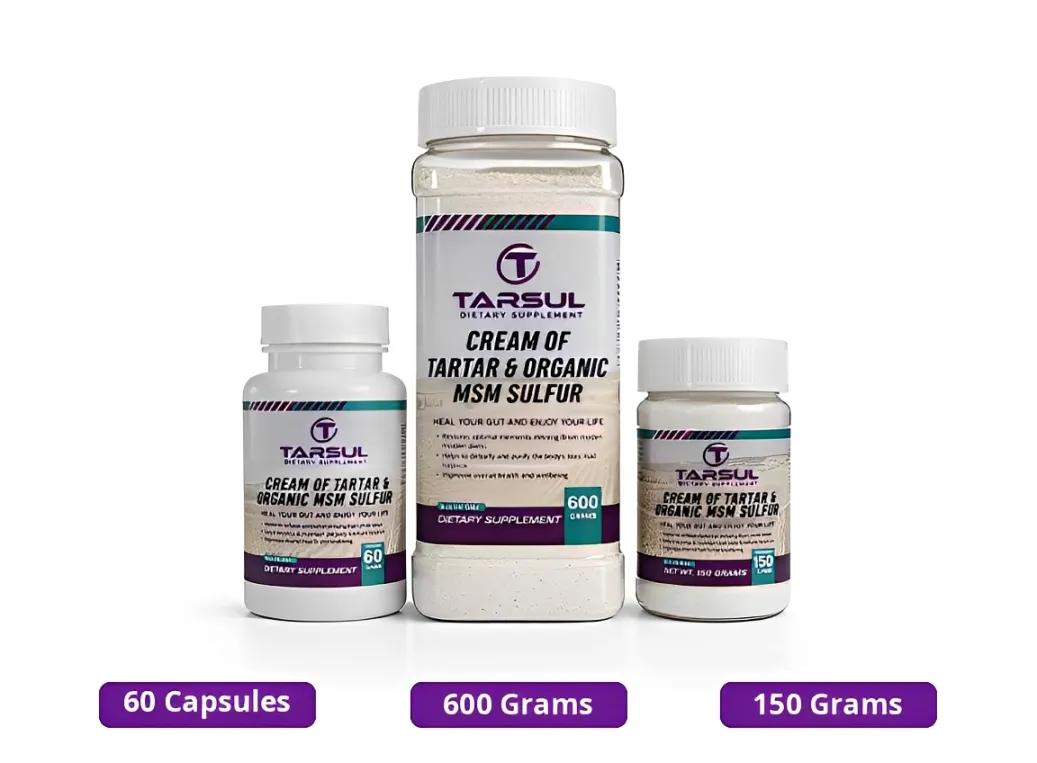
Tarsul is available as powder (150g and 600g bottles) or as sulfur and cream of tartar tablets in 60-capsule bottles, whichever format fits your routine. Sulphur pills in capsule form make daily dosing straightforward, especially for people on the go.
Who Should Be Careful: Safety and Medical Boundaries
Edema is a symptom, not always a standalone condition. Before using any mineral supplement for fluid retention, consider:
- Kidney conditions: Potassium is processed by the kidneys. If you have pre-existing renal issues, high potassium intake may not be appropriate without medical guidance.
- Blood pressure medications: Certain medications, especially ACE inhibitors and potassium-sparing diuretics, already raise potassium levels. Adding potassium supplementation without guidance can cause hyperkalemia.
- Sudden or severe swelling: Rapid-onset edema, especially in the face, abdomen, or lungs, can signal heart failure, liver disease, or kidney failure.
Supplements support optimal mineral balance. They don’t replace a medical evaluation when something more serious may be driving the swelling.
What to Drink and How to Support Fluid Balance Daily
Practical daily habits that actually help:
- Plain water is still the best fluid choice. It supports kidney function without adding sodium.
- Avoid sports drinks unless you’re actively sweating through exercise. Most are high in sodium.
- Reduce processed food sodium. The average American consumes 3,400 mg of sodium daily against a recommended 2,300 mg max.
- Add potassium-rich foods like bananas, sweet potatoes, leafy greens, and avocados.
- A daily supplement with potassium bitartrate and MSM can fill the gap that food alone often can’t, especially for people asking how to alleviate swelling in feet without relying on diuretics.
Fluid retention isn’t a life sentence. For most people dealing with daily swelling, the missing piece isn’t another drug. It’s the mineral their cells stopped getting from food. Start there, and the body often does the rest on its own.
FAQs About Edema and Fluid Retention
What is edema?
Edema is abnormal fluid accumulation in the body’s tissue spaces, most commonly visible as swelling in the legs, feet, ankles, or face. It happens when fluid leaks from capillaries faster than the body can reabsorb it.
What causes edema?
The most common causes are a sodium-potassium imbalance, prolonged sitting or standing, poor venous circulation, and, in more serious cases, heart, kidney, or liver dysfunction.
Can edema kill you?
Peripheral edema (swollen legs and feet) is rarely life-threatening on its own. However, pulmonary edema, or fluid in the lungs, is a medical emergency. If you experience sudden shortness of breath alongside swelling, seek emergency care immediately.
How do you drain edema fluid?
Elevating the limbs helps temporarily. Long-term, restoring the Na⁺/K⁺ cellular balance through potassium replenishment is the most effective way to encourage natural fluid drainage. Movement and compression also support venous return.
What to drink to reduce swelling in feet?
Plain water is ideal. Limiting sodium-heavy drinks like sodas and sports drinks, and increasing potassium intake through food or supplements, helps the kidneys flush stagnant sodium and the fluid it holds.
These statements have not been evaluated by the Food and Drug Administration. This product is not intended to diagnose, treat, cure, or prevent any disease.
More on this topic: see the Edema, Swelling and Fluid-Balance Information hub for the full set of related articles.
Related reading on this topic
- Natural Supplement for Edema
- Natural Diuretic Supplement for Edema
- Natural Supplement for Edema During Pregnancy
- Natural Alternative to Water Pills for Edema
- What is actually in Tarsul, and how it is taken
About this page — last reviewed September 2026
Published by Tarsul, a family-run dietary supplement company operating from San Diego, California since 2010. Written and reviewed in-house by Russ Guillemot, founder, drawing on fifteen years of direct correspondence with customers and wholesale accounts. We are not physicians and nothing here is a diagnosis or a course of treatment.
Where we reference published research we name the authors and the journal so you can look it up yourself. Where something is a common observation rather than a finding, we say so plainly. If a claim cannot be sourced, we leave it out.
Tarsul · 2307 Fenton Parkway #107-42, San Diego, CA 92108 · 619-500-4403 · info@tarsul.com
These statements have not been evaluated by the Food and Drug Administration. This product is not intended to diagnose, treat, cure, or prevent any disease.